 Facebook
 Instagram
 Twitter
 Linkedin
Ayurvedic Management of Hydrocele with Leech Therapy – A Clinical Experience
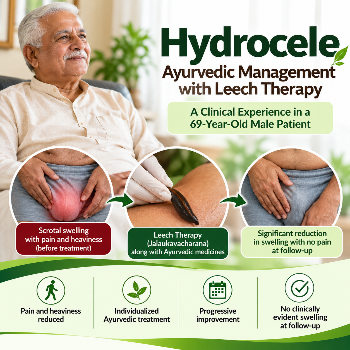
Hydrocele can cause swelling, heaviness and discomfort in the scrotal region. When the swelling becomes significant, even routine activities such as walking may become uncomfortable.
This is the clinical experience of a 69-year-old male patient from Bhawani Mandi, Rajasthan, who travelled for an Ayurvedic consultation after developing hydrocele-associated swelling and discomfort.
One Month of Scrotal Swelling, Pain and Heaviness
The patient had been experiencing the problem for approximately one month.
Before consulting us, he had already undergone evaluation by a conventional medical doctor and an **ultrasound (USG)** had been performed.
His major complaints when he visited were:
- Scrotal swelling
- Pain
- A feeling of heaviness in the scrotum
- Discomfort while walking
The symptoms had become troublesome enough that he was unable to walk comfortably.
Someone known to him suggested that he consult us to explore whether Ayurveda could offer an appropriate management approach.
Clinical Examination and Treatment Planning
When the patient visited, his history was taken and the affected area was clinically examined.
Considering his presentation, Jalaukavacharana (Leech Therapy) was selected as part of his individualized Ayurvedic management.
The procedure and treatment approach were discussed with him, and after his consent, the first Leech Therapy session was performed.
Ayurvedic medicines were also prescribed, and he was asked to return after 7 days for reassessment.
Response After the First Leech Therapy Session
An interesting observation was made following the first procedure.
On clinical observation, the scrotal swelling appeared to have reduced substantially soon after Leech Therapy. We estimated the visible reduction to be approximately 50%, although this was a clinical estimate rather than an ultrasound measurement.
The patient was then advised to continue his prescribed Ayurvedic medicines and return after seven days.
Second Visit – Around 7 Days Later
At the second visit, we again examined the patient.
Compared with his initial presentation, the swelling appeared to have reduced by approximately 80% on clinical assessment.
More importantly, I asked him specifically about the symptoms that had previously been interfering with his daily activities.
He reported that the pain was no longer troubling him and he was able to walk much more comfortably than before treatment.
Considering his clinical response, a second session of Leech Therapy was performed.
He was then prescribed Ayurvedic medicines for another 15 days and advised to return for follow-up.
Third Visit – No Clinically Evident Swelling
When the patient returned for his third visit, there was further improvement.
On physical examination, the previous scrotal swelling was no longer clinically evident.
The patient also reported:
No pain, no heaviness and no previous discomfort while walking.
He was very happy with the improvement because these were the symptoms that had originally brought him for consultation.
As he was asymptomatic and no swelling was evident on clinical examination, the active treatment course was concluded.
Role of Leech Therapy in This Case
Jalaukavacharana (Leech Therapy) is a traditional method of Raktamokshana described in Ayurveda.
In this particular patient, it was incorporated alongside Ayurvedic medicines as part of an individualized management plan.
The clinical progression was encouraging:
Initial visit: Scrotal swelling + pain + heaviness + difficulty walking
After first Leech Therapy: Substantial visible reduction in swelling
7-day follow-up: Approximately 80% reduction on clinical assessment, pain relieved and walking more comfortable
After second Leech Therapy + Ayurvedic medicines: Further improvement
Third visit: No clinically evident swelling and no reported pain, heaviness or discomfort
An Important Point About Hydrocele
A scrotal swelling should not automatically be assumed to be a simple hydrocele.
Clinical examination and, where appropriate, ultrasonography are important because scrotal swelling can have different underlying causes.
The appropriate treatment also depends on factors such as the cause, size, duration, symptoms and overall health of the patient. Conventional surgical management may be recommended for persistent or symptomatic hydroceles in appropriate cases.
Therefore, this individual clinical experience should not be interpreted to mean that every hydrocele can be managed with Leech Therapy or that it replaces surgical treatment when surgery is medically indicated.
Clinical Takeaway
This case involved a 69-year-old man with approximately one month of hydrocele-associated scrotal swelling, pain, heaviness and difficulty walking.
Following clinical assessment, two sessions of Leech Therapy (Jalaukavacharana) along with Ayurvedic medicines were incorporated into his treatment.
During follow-up, the patient reported progressive improvement in pain, heaviness and walking comfort, while physical examination showed progressive reduction in swelling.
By his third visit, no swelling was clinically evident and the patient reported no remaining pain or discomfort.
This was an encouraging clinical experience, while recognizing that individual responses can vary and every case of hydrocele requires appropriate evaluation.
Disclaimer
This article describes an individual patient's clinical experience for educational purposes. It does not establish that Leech Therapy cures hydrocele or guarantee similar outcomes in other patients. Diagnosis and treatment should be based on appropriate clinical evaluation and investigations.




 Youtube
 Select Date