
 Facebook
 Instagram
 Twitter
 Linkedin
A phone for my mother
This Dussehra, I bought a new phone for my mother. The timing was simple: festive offers.
I started with an AI assistant. It helped me narrow down my wishlist and even asked whether my mother was tech-savvy. (She is.) It understood what I needed surprisingly well.
But when it came to where to buy, I didn't quite trust it. So I went back to Google to find stores near me. I compared three, and chose the one with parking.
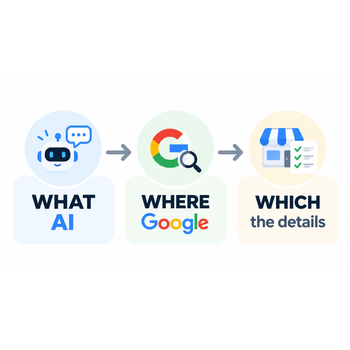
One purchase. Three different influences. And only the last one happened at a counter.
Decision 1: AI decides what to buy
What struck me most was how instinctively I started with AI. I didn't type a few keywords. I described what I wanted, the way I'd ask a knowledgeable friend.
That's a quiet but deep change. For twenty years, search asked us to compress our needs into three words. AI lets us speak in full sentences, and then it does the comparing for us.
The result is a shortlist, written before we have visited a single website or shop.
Decision 2: Google decides where
For where to buy, I trusted the map. Nearby options, distance, reviews, timings: search is still where people check reality.
And AI is increasingly part of that step too. In the search data we study at Vyaparify, business pages appeared more than 3.8 lakh times inside Google's AI answers in just three months (July to October 2026). Not as links in a list, but inside the answer itself. 79% of those appearances were on a phone, which is usually someone close to deciding.
Decision 3: the details decide which
In the end, parking made the decision.
Not price. Not brand. A small, practical detail that one store made easy to find.
This is the part businesses most often overlook. Hours, parking, delivery areas, payment options, whether a product is in stock: these are the facts people use to choose between two good options. If they aren't visible, a business can lose a customer it had already won on product and price.
Why this matters to me: payment comes last
I spent about twenty years in banking, the last decade leading a merchant business. I saw transactions every single day. What I never saw was why the customer chose that shop.
Payment is the last step of a decision made much earlier, in a conversation, a search, and now an AI answer. That's why I moved from payments to discovery. The customer's decision begins long before the counter, and that's where businesses are now won or lost.
What every business can learn from one purchase
Whether you run a retail chain, a clinic, a D2C brand or a neighbourhood store, you now compete in three moments:
1. Be understood by AI. Describe what you offer clearly, specifically and consistently: products, services, prices, location. AI recommends what it can understand.
2. Be found where people search. Keep your Google Business Profile, website and listings complete and consistent. Most people decide on a phone, close to the point of purchase.
3. Make the deciding details visible. Parking, hours, delivery, payment options, stock. These small facts often decide between you and the next option.
Here's an encouraging finding from our data. Of 736 businesses we saw appear in Google's AI answers, 514 barely showed up in ordinary search results for their category. AI found them because their pages explained clearly what they were. Clarity, more than size, is opening the door.
The early-2000s moment, again
This reminded me of the early 2000s, when the internet entered our lives. Within a few years, we couldn't imagine buying anything without it.
AI feels like that moment now. It has already changed how I decide what to buy. The businesses that adapt early, by making themselves easy for both people and AI to understand, will be the ones customers choose.
Have you noticed this shift in your own buying habits? I'd love to hear about it. Share your experience with us on LinkedIn.
See how AI and Google see your business. [Check your AI and Google visibility →] (link to the Agentic Readiness Score page, or to the "Be The Answer: AI & Google Visibility" service page until the score is live)
Source note: the AI-answer figures come from Vyaparify's Google Search Console data, AI features report, 13 July–12 October 2026. They show appearances, not purchases.


 Website
 Youtube
 Select Date

